Socialization is a process through which individuals learn how to behave appropriately in a particular society. It is described by David Newman as a transformation wherein “the needs of the society become the needs of the individual” (Newman, 137). The socialization process is by definition not static, nor is it something we undergo during a confined time frame of our lives. It continues over the span of our lives, ever evolving in response to cultural shifts and demands of society.
Institutions serve as vehicles through which social skills, values, and other cultural elements, all inherent to the socialization process, are transmitted to the population. Religion is one such institution. In fact, religion has long been considered of the most powerful institutions worldwide, along with education, and mass media. However, in recent years, the role of religion in socialization has been called into question. Three specific patterns in religious affiliation have emerged within the US, which have the power to collectively change the role religion plays in socialization.
The first of these movements has shown particular disease with the role religion currently plays as an institutional body in the US. Individuals on this end of the spectrum are generally grouped together under the category “unaffiliated.” They include individuals who have, never been a part of a religious tradition or have left the tradition they were once apart of. Agnostics, atheists, and people who consider themselves spiritual, but aren't associated with a specific tradition also fall into this category.
Figure 1: Pew Research Center
In 2012, the Pew Forum on Religious and Public Life released a poll depicting trends in religious affiliation in the US over the span of five years (figure 1). From this data we can conclude that since 2007, the number of people who consider themselves Christian has been decreasing and the number of people who consider themselves unaffiliated has been increasing.
Figure 2: Pew Research Center
Another interesting poll from the Pew Research Center shows views among the general public, religiously unaffiliated individuals, and religiously affiliated individuals regarding religious institutions (figure 2). Considering this poll in relation to the rise of unaffiliated individuals within the US, a question regarding the future of religion as a powerful social institution arises: Is it the fate of religion to become a more individualized realm in society, with diminishing power as an institution driving socialization processes?
Before we jump to conclusions, let us consider the resurgence of religious fundamentalism and the popularity of new religious groups in post modern America. Geoff Boucher describes the fundamentalist's view of religion as “cultural cement” (Boucher, 2006). A perceived inerrancy of the Bible, in the case of Christian fundamentalist groups, has led some individuals to criticize political policies such as legal abortion, as well as institutional bodies, such as schools, for teaching scientific evolution to children, for example. Thus, fundamentalist groups typically aim to be highly involved in the socialization process, and require an institutional body through which they can voice their beliefs. Relatively new religious groups also promote the existence of socialization via religion. Consider this statement while viewing one of the Church of Scientology's television advertisements below.
This advertisement actively reinforces the acquisition of self, a “unique set of traits, behaviors, and attitudes that distinguishes one person from the next” (Newman, 137). Newman describes the self as “the most important outcome of the socialization processes” (Newman, 137). The video shows that the Church of Scientology, founded by L. Ron Hubbard in 1952, welcomes various kinds of “selves,” including innovators, rebels, and artists, young and old. By emphasizing the self, the Church of Scientology is showing its role as an agent of socialization.
The examples above, though from various parts of the religious spectrum, are all profound indicators of the changing nature of culture. It is clear that the role of religion in socialization is in a state of flux. With the polarization of attitudes regarding religion in the US, our society has been forced to take a close look at the intricacies of religious institutions in order to determine for ourselves, and as a collective society, what role we want them to play as agents of socialization in the future.
Sources: Newman, David (2012). Sociology: Exploring the Architecture of Everyday Life: 9th Edition. SAGE Publications.
Culture and normative behavior are things which individuals in any given society are constantly surrounded by. They influence our actions and assist us in interpreting our experiences. However, as a result of their ubiquity, they may come to seem invisible, taken for granted due to their commonplace nature. Often times, the only instance in which an individual would become aware of the existence of normative behavior is if it were violated, either by themselves or another individual, in terms of the codes of conduct established by their respective culture. The sanction, or the direct social response to the violation, serves as a reinforcement of that culture's norms, momentarily reminding witnesses of the boundaries which confine their thoughts, words and actions.
In Sociology: the architecture of everyday life, David Newman states that “similarity breeds comfort; difference breeds discomfort” (Newman, 115). Despite the truth that lies within this statement, I find it problematic especially in consideration of the exponential intensification of transnational human connections the world has seen in recent decades. In a world where humans from different societies, with different cultures, and different ideas about what constitutes normative behavior are interacting with one another more and more regularly, how are we to deal with the seemingly unavoidable discomfort of clashing norms?
I have come across various responses to this question, many of which resort to education about foreign cultures as a way to reduce the discomfort of difference. Reading about the foreign culture and becoming familiar with their norms before the actual encounter is intended to reduce the likelihood of the awkward cultural clashes which could ultimately be highly offensive.
Figure 1: New York Times (Click to enlarge)
One example of such education is in the form of “Culture Smart Cards,” distributed by the US Marine Corps to US military personnel in Afghanistan and Iraq (Newman, 116). Figure 1 shows some of the information distributed, including simple bullet points under the headings “do this,” and “don't do this.” There are also illustrations to indicate the meaning of gestures in Iraq, a mode of communication especially important when language skills are lacking. Such guides, though clearly limited in their scope, allow soldiers to communicate within the socially acceptable boundaries of the country in order to establish rapport with locals and avoid the potentially harmful consequences of miscommunication.
Figure 2: tower.com
Another example of the use of education to decrease violations of norms cross culturally is in the realm of business where one action lying outside of normative boundaries could cost millions of dollars. There are countless books on the market geared towards international business men and women aiming to learn about foreign business culture and norms in order to be successful in their international encounters. Figure 2 highlights a guidebook specifically for Americans doing business in China. This is a particularly common paradigm within the genre.
The two examples above show the significant steps taken to “stay comfortable” by decreasing the probability of discomfort via education allowing an individual to adapt to foreign customs. While this seems like a perfectly reasonable response to questions about culture and normative behavior in the age of globalization, I am slightly resistant to this resolution. Being uncomfortable, stepping out of your comfort zone, so to speak, is important in any learning experience, cross-cultural culture and normative behavior included. Experiencing discomfort as a result of encountering violations of normative behavior will shed light on the power of the human constructions more so than reading about such interactions in a book, thus making it a healthy supplement to "armchair" assumptions about culture and normative behavior in other societies.
Personal billboards "advertise a reality to others about who we are, what we stand for, and what we consider important" (Newman, 73)
Personal License Plate, Blog as Billboard
I created a license plate from Tennessee, the state in which I was born. As a practitioner of yoga and a follower of the eight-fold path, I consider myself a yogi! While I can't actually put this plate on my car, I have used my blog as a place to showcase it - though this decision was, of course, shaped by the SOC1110 syllabus!
Vote NO
mnunited.org
The 2012 election was of significant importance to me for a number of reasons, most notably that it was the first presidential election I was able to vote in. In addition to this, a constitutional amendment to ban gay marriage was on the ballots. Voting “no” on the marriage amendment was something I felt very strongly about.
In the months leading up to the election, I was browsing the Minnesotans United for all Families website and ended up ordering a bumper sticker in order to show my support and solidarity with the LGBT community. Upon it's arrival I proudly pasted it onto my car, joining many other individuals in the Twin Cities who had erected “Vote No” signs on their lawns, and sported t-shirts and pins with the slogan.
Of course it wasn't the personal “Vote No” billboards alone which caused the ultimate rejection of the amendment. However, Minnesotans, like Becker's moral entrepreneurs (1963), who "by virtue of their initiative... skillful use of publicity and public relations... are able to turn their interests into public policy" (Hills, 1980).
Global Seva Challenge
offthematintotheworld.org
The Global Seva Challenge is a yearly international service project sponsored by Off the Mat, Into the World (OTM), a nonprofit organization whose mission is to "use the power of yoga to inspire conscious, sustainable activism and ignite grassroots social change” (offthemetintotheworld.org).
The 2012 Global Seva Challenge was focused on raising awareness of the global sex trafficking industry in India, and providing refuge and rehabilitation for survivors. In order to spread awareness of the cause, and send proceeds to the organization, I purchased a tank top with the 2012 Global Seva Challenge logo on the front, and the Off the Mat, Into the World logo on the back. In wearing the tank top, I advertise the existence of a reality most people in the US do not experience, and perhaps aren't even aware of.
Be You Melrose
“Be You is an eating disorder prevention and early intervention campaign sponsored by Park Nicollet Melrose Institute. It’s meant to instill positive body image in yourself and help you encourage it in others” (facebook.com/beyoumelrose)
Be You is a campaign I hold close to my heart. In September, 2012, at Minnesota's first National Eating Disorder Awareness walk, I picked up a Be You bumper sticker which simply states “be vibrant,” with “#beyoumelrose” written in a smaller font in the bottom right corner. I stuck the saying on my laptop in such a way that when it is open, people across from me can read it. My hope is that perhaps just one unknowing stranger will punch #beyoumelrose into their twitter account, or search “Be You Melrose” on Google to learn about the movement.
The Value of Personal Billboards
I believe personal billboards are a powerful way of voicing your opinions and sharing your beliefs. Though silent, these billboards are powerful in that they influence viewers on a subconscious level, shaping their perception of reality (Newman, 73). The three examples I have given above attest to my own use of personal billboards, all of which have an impact, no matter how subtle, on the individuals who are exposed to them. Even as you are reading this very blog post, you are being influenced by the images I have uploaded and the commentary I have attached to them.
Furthermore, I consider personal billboards of great value for their power of exceeding the “personal,” forming bonds among individuals who choose to present the same images to the public. Individuals toting paraphernalia from the same sports team, or wearing the same concert tee, may automatically feel a sense of understanding among one another, or at the very least, a sense of common ground. Symbols, such as personal billboards, which allow individuals to relate to one another, thus shed light on the intricate workings of societies.
Sources:
Newman, David (2012). Sociology: Exploring the Architecture of Everyday Life: 9th Edition. SAGE Publications. (p.1-52) Becker, H.S. (1963). Outsiders: Studies in the sociology of deviance. New York, NY: Free Press Hills, S. (1980). Demystifying social deviance. New York, NY: McGraw-Hill. http://www.mnunited.org http://www.facebook.com/beyoumelrose http://www.offthematintotheworld.org
Here's a neat video with footage from social psychologist Stanley Milgram's original obedience study, a classic piece of social research on the powerful tendency for ordinary people to defer to authority (Blass, 2004). I've encountered this study in past psychology classes, and am always left wondering what I would do if put in the "teacher" role in this experiment. Would I dare continue to flip the switch? Milgram's haunting study has certainly opened up some greater questions about human civilization:
"Can an ordinary, decent person be pressured by another to commit an act of extreme cruelty? Or, conversely, do cruel actions require inherently cruel people?" (Newman, 2012)
Sources: Newman, David (2012). Sociology: Exploring the Architecture of Everyday Life: 9th Edition. SAGE Publications. (p.1-52) Blass, T. (2004). The man who shocked the world: The life and legacy if Stanley Milgram. New York, NY: Basic Books http://www.youtube.com/watch?feature=player_embedded&v=W147ybOdgpE
The sociological imagination proposed by C.Wright Mills (1959) illuminates the impact various phenomena, including social forces and historical events, have on individuals and how such events shape individuals' lives. Simultaneously, individuals affect the very social structures which have affected them (Newman,49). The field of sociology encourages us to look beyond individualistic explanations to incorporate world events, political concerns, and economic trends, among other things, into our consideration of how individuals interact with one another and how they make sense of their lives. Armed with my new-found sociological imagination, I am traveling back to the year 2004, along with my 12-year-old self, and sociological goggles for viewing, to examine a selection of societal events that were unfolding, to analyze how their existence influenced the person I have become, and in turn, how I have affected this very social structure.
A few snapshots of events on the world stage will serve to refresh our memories of life on planet Earth nine years ago:
President George W. Bush won a second term in the White House, claiming victory over Democrat, John Kerry, in the US presidential election.
Getty Images
The war in Iraq continued, death tolls rose significantly.
http://musingsoniraq.blogspot.nl/
191 people were killed, and nearly 2,000 injured in Madrid train bombings.
The Associated Press
Two mobile robots, Spirit and Opportunity, landed on Mars for NASA's Mars Exploration Rover project.
Mars Exploration Rover Mission, JPL, NASA
And who could forget Janet Jackson's infamous wardrobe malfunction during the half-time show at the Super Bowl?
Getty Images
The events shown above were certainly memorable and have without doubt affected my life in one way or another. However, two key series of events in 2004 stand out in my memory most clearly. I believe that the following events had the most lasting impacts of my life after age 12 and continue to influence my actions and view points today.
The first of these is the series of natural disasters which occurred throughout the year. In South Asia, the monsoon season killed over 1,800 people and was dubbed the worst flooding in India, Nepal and Bangladesh in fifteen years (infoplease.com). The Atlantic was met with a record breaking hurricane season. Hurricane Jeanne was the last of four hurricanes to strike Florida within a period of six weeks and caused death and destruction in Puerto Rico, the Bahamas and the Southeastern US (hurricanescience.org). Japan also broke records after being struck by 10 cyclones; The previous record was 6 (hurricanescience.org). The year culminated in the earthquake that spawned the Indian Ocean Tsunami. As the India plate slid under the Burma plate of the Earth's crust, an earthquake of 9.0 magnitude ensued, unleashing energy which sent a tsunami straight to the coast of South Asia. By the end of the day, 150,000 people were dead or missing, and millions of individuals were left homeless (news.nationalgeographic.com).
AP, Getty Images
I began to question the occurrence of these events. What can I do to help those suffering? Is there a reason why so many natural disasters occurred within such a small time frame? Will these trends continue? As documentation of mother nature's calamities continued, I began noticing climate change as a key term arising in response. Just over a year later, the documentary, An Inconvenient Truth, was released, aiming to raise awareness about “global warming.” The frog test video below has since loomed in my memory.
These natural disasters raised my consciousness of the power of nature and the importance of protecting planet Earth in the face of climate change. Now, I make significant efforts to live a green lifestyle and be environmentally mindful. One of the reasons I am a vegetarian is because of the negative impact of meat production on the environment. I use re-usable bags and water bottles religiously, and aim to purchase eco-friendly products so as to reduce my carbon footprint. I believe that these practices are partially a result of the natural disasters I witnessed, and the various responses I heard, both through mass media outlets. The sociological imaginary has allowed me to see that my environmentalist attitudes were in part constructed by these outside stimuli.
While the choices I now make are influenced by society, they also actively impact the social structure I am immersed in. For example, the term "green lifestyle" is a social construct, which independent of human interaction would be a meaningless statement. Via my actions described above, and writing about this lifestyle in a public blog post, I am reaffirming what a green lifestyle looks like, in the form of symbolic communication (Newman, 48). Furthermore, by taking action to live a "greener" life, I am making an impact on the planet, and setting an example of values to individuals around me.
I now donate money when similar natural disasters, such as the 2010 earthquake in Haiti and the 2011 tsunami in Japan, occur. My donations to funds for these disasters may be spurred on by the feelings of hopelessness I experienced while watching news footage in 2004. Although I am unable to contribute much in the grand scheme of things, contributions to charities make a difference, no matter how small, thus illustrating that my actions, though shaped by historical events, assist in shaping society.
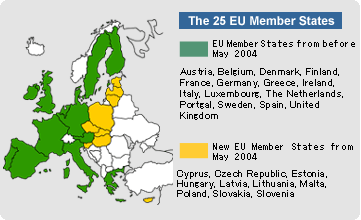
Another memorable event in 2004 was the largest expansion of the European Union to date. During the year, the accession of 10 countries from Central and Eastern Europe, and the Mediterranean brought the number of nation-states in the EU to a total of 25. The BBC noted that this made the EU, in terms of population, the largest single market in the world (news.bbc.co.uk). After years of crumbling empires, long-lasting wars and tensions between nation-states in the region, the world began to witness what appeared to be a reunification of Europe.
mofa.go.jp
The expansion had a particularly profound effect on me, even more so considering that I was living in Germany at the time. It was one of the most palpable political events I had encountered, especially on a global scale. I believe that witnessing nation-states in the EU working together in the pursuit of peace and economic prosperity helped determine which field of study I would later become interested in. I have become fascinated by the processes of globalization, and recently declared my major in global studies. Ideas planted in 2004 in my 12-year-old mind about transcending national boundaries have influenced my current view of myself as a citizen in the world community (Newman, 37). The increasingly interconnected globe has strongly influenced the path I have taken and will likely continue to take in my academic life. The global sentiments I have influence society in the interactions I have with others, and may continue to do so in a future career path.
Perhaps if I had been 12 in 2000, or 2008, I would have turned out to be a completely different individual, with different goals and passions. These changes in my mindset would have not only affected my life, but the lives of all of the individuals I would have encountered. Together, my 12-year-old self and I have illustrated both sides of David Newman's sociological coin (2012). Forces beyond my direct control have, and will continue to shape my life. Clearly, mass media, a powerful social institution, has significantly influenced my opinions and values. However, in assessing my life through sociological lenses, I realize that I am not a powerless robot, "programmed by social structure," left at the mercy of its forces (G. Swanson, 1992, p.94). Rather, I am an active participant, influencing the social systems I am a part of.
Newman, David (2012). Sociology: Exploring the Architecture of Everyday Life: 9th Edition. SAGE Publications. (p.1-52) Swanson, G. (1992). Doing things together: On some basic forms of agency and structuring in collective action and on some explanations for them. Social Psychology Quarterly, 55, p.94